> ## Documentation Index
> Fetch the complete documentation index at: https://auth0.com/llms.txt
> Use this file to discover all available pages before exploring further.
> Walkthrough for Okta Connection Setup via SAML SCIM
# Inbound SCIM for Okta Workforce SAML Connections
Create a [SAML Connection](/docs/authenticate/identity-providers/enterprise-identity-providers/saml) in your Auth0 tenant and [connect it to a corresponding custom SAML application](https://help.okta.com/en-us/content/topics/apps/apps_app_integration_wizard_saml.htm) in your Okta Workforce Identity Dashboard.
This section describes how to configure a custom SAML and SCIM app integration in an Okta Workforce Identity tenant, which can be used to provision users to your Auth0 SCIM endpoint.
## Configure SCIM settings in Auth0
1. Launch the [Auth0 Dashboard](https://manage.auth0.com/#/) and go to **Authentication > Enterprise > SAML > \[Connection] > Provisioning.**
2. Disable **Sync user profile attributes at each login** unless you want to [sync additional attributes at login](/docs/authenticate/protocols/scim/configure-inbound-scim).
3. In the same section, enable **Sync user profiles using SCIM**.
4. Under the **Mapping** tab, ensure the **SCIM attribute containing the User ID** setting is set to **userName**.
5. Review the **Additional Mappings** to ensure the extended SCIM attributes are mapped to your preferred Auth0 attributes, reviewing [attribute mapping](/docs/authenticate/protocols/scim/configure-inbound-scim#attribute-mapping) for details. If you receive phone numbers and physical addresses, note that Okta Workforce sends these as `phoneNumbers[primary eq true].value` and `addresses[primary eq true].*` by default.
6. Map the SCIM `userName` attribute to the Auth0 `email` attribute so Okta can [find and match existing users](https://developer.okta.com/docs/reference/scim/scim-20/) if this connection has already been deployed to production using the email address as the login ID and no Auth0 `username` attribute is set on the existing user profiles. In **Additional Mappings** find the following attribute pair:
```json lines theme={null}
{
"scim": "userName",
"auth0": "username"
}
```
Replace it with the one below, then remove the mapping to `emails[primary eq true].value`.
```json lines theme={null}
{
"scim": "userName",
"auth0": "email"
}
```
7. Choose **Save Changes.**
## Retrieve SCIM endpoint URL and token
1. In the Auth0 dashboard, browse to the SCIM **Setup** tab and copy the **SCIM Endpoint URL,** then paste it somewhere safe.
2. Select **Generate New Token** and set an optional expiration date for the token. You can optionally select the scopes you want to grant to Okta Workforce; the default scopes used by Okta Workforce are `get:users`, `post:users`, and `put:users`. You may optionally select `get:groups`, `post:groups`, `put:groups`, `patch:groups`, and `delete:groups` to provision groups.
## Configure SCIM in Okta Workforce for SAML Apps
There are two ways to configure SCIM provisioning in Okta. Choose the method that matches your connection type and group size requirements:
| Method | Description | Considerations |
| ----------------------------- | ---------------------------------------------------------------------------------------------------------------------------------------------------------------------------------------------------------------------- | -------------------------------------------------------------------------------------------------------------- |
| **SAML application** | Uses the existing **Provisioning** tab for SAML applications in Okta. This method does not support the `PATCH` for groups, limiting the maximum group members to what can be sent in a single `POST` or `PUT` request. | Appropriate for pushing users. Does not support pushing groups with more than 10,000 members. |
| **SCIM template application** | Uses a SCIM 2.0 template app in Okta that supports the SCIM `PATCH` method with groups. Required for pushing groups over 10,000 members. | Works alongside existing SAML or OIDC SSO integrations. Supports pushing groups with more than 10,000 members. |
### Okta SAML application
1. Go to your Okta Workforce Identity SAML application, select the **General** tab, then choose **Edit** for **App Settings.**
2. In the **Provisioning** section, select **SCIM** and then **Save**.
3. Under the **General** tab, also confirm that [Federation Broker Mode](https://help.okta.com/en-us/content/topics/apps/apps-fbm-main.htm) is disabled.
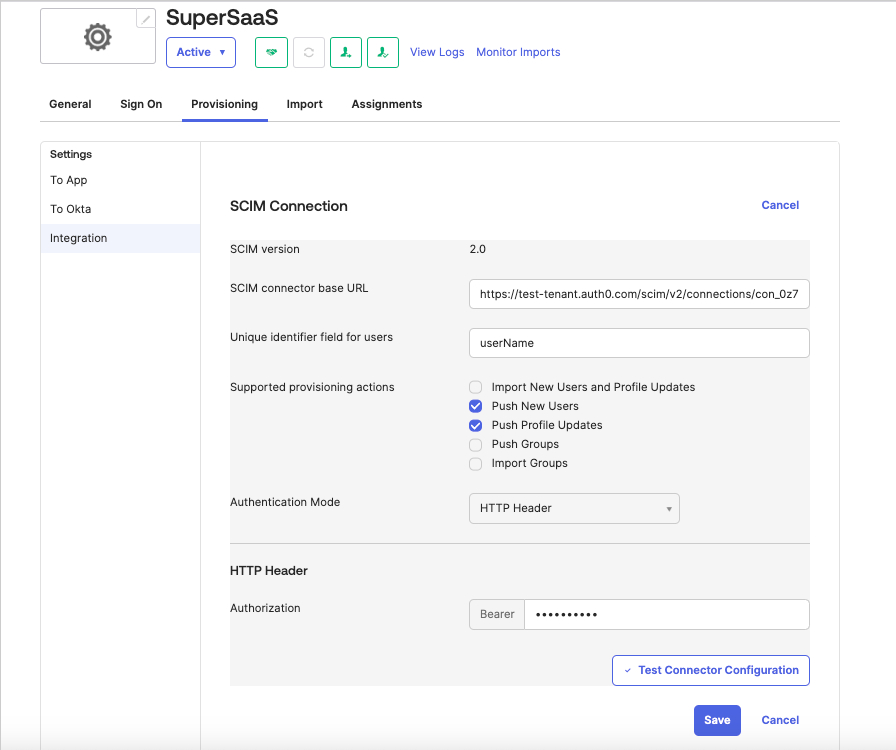
4. Select the **Provisioning** tab, then go to **Integration** tab and select **Edit**.
5. Enter the **SCIM Endpoint URL** value you copied earlier into the **SCIM connector base URL** section.
6. For **Unique identifier field for users**, enter **userName**.
7. Under **Supported provisioning actions**, select `Push New Users`, `Push Profile Updates`, and optionally `Push Groups`. Choose **HTTP Header** as the **Authentication Mode.**
8. Paste the SCIM token into the **Authorization** field, then choose **Test Connection Configuration** if you want to test the new connection. Select **Save**.
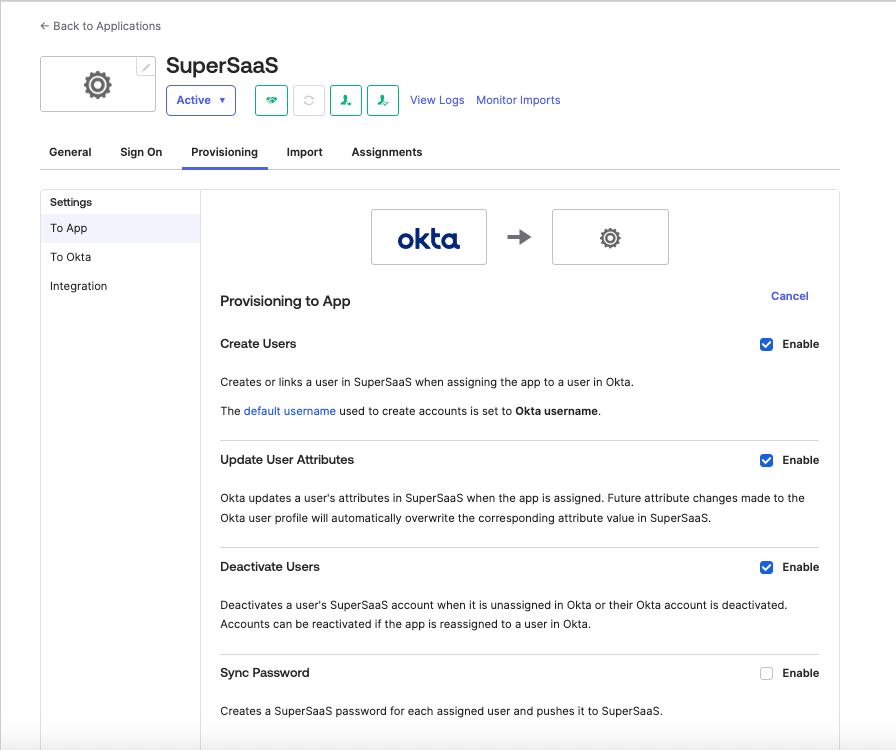
 9. Browse to **Provisioning > Settings > To App** and choose **Edit,** then enable the **Create Users, Update User Attributes,** and **Deactivate users** operations. Select **Save**.
 10. Under the **Attribute Mappings** section, use the **X** button to **delete** the following lines:
| Attribute | Value |
| ------------------ | ------------------------------------------------------------------------ |
| Primary email type | `(user.email != null && user.email != '') ? 'work' : ‘'` |
| Primary phone type | `(user.primaryPhone != null && user.primaryPhone != '') ? 'work' : ‘'` |
| Address type | `(user.streetAddress != null && user.streetAddress != '') ? 'work' : ‘'` |
Use the **Attribute Mappings** section to configure any additional SCIM attributes you want Okta to send to your SCIM endpoint. If you add custom attributes, they must include a valid SCIM 2.0 external namespace property. For more information on external namespaces, read [Okta's help section](https://support.okta.com/help/s/article/Receiving-Invalid-externalNamespace-task-error-when-assigning-a-user-to-a-SCIMenabled-application).
11. Use the **Assignments** tab to assign users and/or groups to your application. Assigning a group provisions its users into your Auth0 tenant.
12. To push groups, select the **Push Groups** tab, find and select the group to push, then select **Save**. For more information, read [Okta's App assignments and Group Push documentation](https://help.okta.com/en-us/content/topics/users-groups-profiles/usgp-group-push-main.htm).
### Okta SCIM template application
1. In the Okta portal, select **Applications > Browse App Catalog**, search for **(OAuth Bearer Token) Governance with SCIM 2.0**, and select **Add Integration**. Set an **Application label**, check **Do not display application icon to users**, uncheck **Browser plugin auto-submit**, then select **Next** and **Done**.
2. From the integration's settings page, select the **Provisioning** tab, then **Configure API Integration**. Check **Enable API Integration**. Copy the **SCIM Endpoint URL** from the Auth0 Dashboard **Setup** tab and paste it into the **SCIM 2.0 Base URL** field, removing any trailing forward slash. In the Auth0 Dashboard, select **Generate New Token > Generate Token > Copy and Close**, then paste the token into the **OAuth Bearer Token** field in Okta. Optionally select **Test API Credentials**, then select **Save**.
3. Next to **Provisioning To App**, select **Edit**. Enable only: **Create Users**, **Update User Attributes**, and **Deactivate Users**. Uncheck **Set password when creating new users**, then select **Save**.
4. Under **Attribute Mappings**, use the **X** button to delete these lines, which can cause issues during `PUT` operations:
| Attribute | Value |
| ------------------ | ------------------------------------------------------------------------ |
| Primary email type | `(user.email != null && user.email != '') ? 'work' : ''` |
| Primary phone type | `(user.primaryPhone != null && user.primaryPhone != '') ? 'work' : ''` |
| Address type | `(user.streetAddress != null && user.streetAddress != '') ? 'work' : ''` |
Optionally configure additional SCIM attributes to send from Okta to your SCIM endpoint.
5. Use the **Assignments** tab to assign users and/or groups to your application. Assigning a group provisions its users into your Auth0 tenant.
The same groups and users must be assigned to both the SSO app instance and the SCIM app instance in Okta.
6. To push groups, select the **Push Groups** tab, find and select the group to push, then select **Save**. This provisions the full group object to Auth0. For more information on the relationship between Group Push and assignments, read [Okta's App assignments and Group Push documentation](https://help.okta.com/en-us/content/topics/users-groups-profiles/usgp-group-push-main.htm).
10. Under the **Attribute Mappings** section, use the **X** button to **delete** the following lines:
| Attribute | Value |
| ------------------ | ------------------------------------------------------------------------ |
| Primary email type | `(user.email != null && user.email != '') ? 'work' : ‘'` |
| Primary phone type | `(user.primaryPhone != null && user.primaryPhone != '') ? 'work' : ‘'` |
| Address type | `(user.streetAddress != null && user.streetAddress != '') ? 'work' : ‘'` |
Use the **Attribute Mappings** section to configure any additional SCIM attributes you want Okta to send to your SCIM endpoint. If you add custom attributes, they must include a valid SCIM 2.0 external namespace property. For more information on external namespaces, read [Okta's help section](https://support.okta.com/help/s/article/Receiving-Invalid-externalNamespace-task-error-when-assigning-a-user-to-a-SCIMenabled-application).
11. Use the **Assignments** tab to assign users and/or groups to your application. Assigning a group provisions its users into your Auth0 tenant.
12. To push groups, select the **Push Groups** tab, find and select the group to push, then select **Save**. For more information, read [Okta's App assignments and Group Push documentation](https://help.okta.com/en-us/content/topics/users-groups-profiles/usgp-group-push-main.htm).
### Okta SCIM template application
1. In the Okta portal, select **Applications > Browse App Catalog**, search for **(OAuth Bearer Token) Governance with SCIM 2.0**, and select **Add Integration**. Set an **Application label**, check **Do not display application icon to users**, uncheck **Browser plugin auto-submit**, then select **Next** and **Done**.
2. From the integration's settings page, select the **Provisioning** tab, then **Configure API Integration**. Check **Enable API Integration**. Copy the **SCIM Endpoint URL** from the Auth0 Dashboard **Setup** tab and paste it into the **SCIM 2.0 Base URL** field, removing any trailing forward slash. In the Auth0 Dashboard, select **Generate New Token > Generate Token > Copy and Close**, then paste the token into the **OAuth Bearer Token** field in Okta. Optionally select **Test API Credentials**, then select **Save**.
3. Next to **Provisioning To App**, select **Edit**. Enable only: **Create Users**, **Update User Attributes**, and **Deactivate Users**. Uncheck **Set password when creating new users**, then select **Save**.
4. Under **Attribute Mappings**, use the **X** button to delete these lines, which can cause issues during `PUT` operations:
| Attribute | Value |
| ------------------ | ------------------------------------------------------------------------ |
| Primary email type | `(user.email != null && user.email != '') ? 'work' : ''` |
| Primary phone type | `(user.primaryPhone != null && user.primaryPhone != '') ? 'work' : ''` |
| Address type | `(user.streetAddress != null && user.streetAddress != '') ? 'work' : ''` |
Optionally configure additional SCIM attributes to send from Okta to your SCIM endpoint.
5. Use the **Assignments** tab to assign users and/or groups to your application. Assigning a group provisions its users into your Auth0 tenant.
The same groups and users must be assigned to both the SSO app instance and the SCIM app instance in Okta.
6. To push groups, select the **Push Groups** tab, find and select the group to push, then select **Save**. This provisions the full group object to Auth0. For more information on the relationship between Group Push and assignments, read [Okta's App assignments and Group Push documentation](https://help.okta.com/en-us/content/topics/users-groups-profiles/usgp-group-push-main.htm).