> ## Documentation Index
> Fetch the complete documentation index at: https://auth0.com/llms.txt
> Use this file to discover all available pages before exploring further.
> Learn how to configure Auth0 as an identity provider using the SAML2 Web App addon for a GitHub Enterprise Cloud (github.com) organization.
# Configure GitHub Enterprise Cloud as SAML Service Provider
You can configure Auth0 to serve as an identity provider for [GitHub Enterprise Cloud](https://help.github.com/en/articles/about-authentication-with-saml-single-sign-on) (github.com). GitHub requires an enterprise-level subscription to enable using an external SAML IdP.
* To learn about SSO on GitHub, read [About authentication with SAML single sign-on](https://help.github.com/en/articles/about-authentication-with-saml-single-sign-on) on [https://docs.github.com](https://docs.github.com).
* To learn how to configure Auth0 as the identity provider for GitHub Enterprise Server (private instance), read [Configure Auth0 as Identity Provider for GitHub Enterprise Server](/docs/authenticate/single-sign-on/outbound-single-sign-on/configure-auth0-saml-identity-provider/configure-saml2-web-app-addon-for-github-enterprise-server).
## Configure SAML SSO on Auth0
1. Go to [Dashboard > Applications > Applications](https://manage.auth0.com/#/applications) and create a new application. Give it a meaningful name like **GitHub**. You can choose any application type, but the **Regular Web App** type is recommended.
2. Go to the [Addons](https://manage.auth0.com/#/applications/\{yourClientId}/addons) tab and enable the **SAML2 Web App** toggle.
3. On the **Settings** tab, set the **Application Callback URL** to: `https://github.com/orgs/{YOUR_GITHUB_ORG_NAME}/saml/consume`.
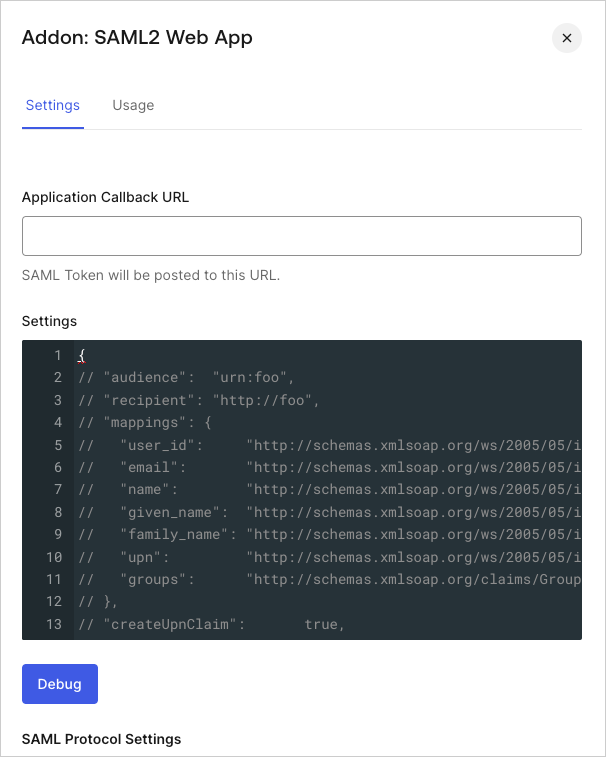 4. Paste the following code into the **Settings** text box and click **Debug**.
```json lines theme={null}
{
"audience": "https://github.com/orgs/{yourGitHubOrgName}",
"mappings": {
"user_id": "http://schemas.xmlsoap.org/ws/2005/05/identity/claims/nameidentifier",
"email": "emails",
"name": "full_name"
},
"passthroughClaimsWithNoMapping": false,
"mapIdentities": false,
"signatureAlgorithm": "rsa-sha256",
"digestAlgorithm": "sha256",
"nameIdentifierProbes": [
"http://schemas.xmlsoap.org/ws/2005/05/identity/claims/nameidentifier"
]
}
```
1. Replace `{YOUR_GITHUB_ORG_NAME}` with the GitHub organization name that corresponds to your subscription. The mapping will send the `user_id` as the **Name Identifier** to GitHub. This is a good option if you enable more than one connection for the GitHub application, as it will ensure uniqueness (every user will have a different ID).
2. If you are using a single connection, you might want to use the `nickname` or another unique identifier as a friendlier **Name Identifier** (but make sure that the property you choose is unique). As an example, if you want `nickname` as the **Name Identifier**, the `mappings` section above will look like this:
5. Scroll to the bottom of the tab and click **Enable**.
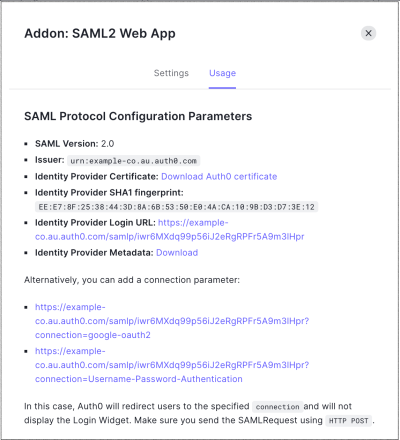
6. On the **Usage** tab, locate **Identity Provider Metadata** and click **Download** to download the metadata file. You will need this when you configure Auth0 as the identity provider.
4. Paste the following code into the **Settings** text box and click **Debug**.
```json lines theme={null}
{
"audience": "https://github.com/orgs/{yourGitHubOrgName}",
"mappings": {
"user_id": "http://schemas.xmlsoap.org/ws/2005/05/identity/claims/nameidentifier",
"email": "emails",
"name": "full_name"
},
"passthroughClaimsWithNoMapping": false,
"mapIdentities": false,
"signatureAlgorithm": "rsa-sha256",
"digestAlgorithm": "sha256",
"nameIdentifierProbes": [
"http://schemas.xmlsoap.org/ws/2005/05/identity/claims/nameidentifier"
]
}
```
1. Replace `{YOUR_GITHUB_ORG_NAME}` with the GitHub organization name that corresponds to your subscription. The mapping will send the `user_id` as the **Name Identifier** to GitHub. This is a good option if you enable more than one connection for the GitHub application, as it will ensure uniqueness (every user will have a different ID).
2. If you are using a single connection, you might want to use the `nickname` or another unique identifier as a friendlier **Name Identifier** (but make sure that the property you choose is unique). As an example, if you want `nickname` as the **Name Identifier**, the `mappings` section above will look like this:
5. Scroll to the bottom of the tab and click **Enable**.
6. On the **Usage** tab, locate **Identity Provider Metadata** and click **Download** to download the metadata file. You will need this when you configure Auth0 as the identity provider.
 ## Configure SAML SSO on GitHub
1. Follow the instructions in GitHub for [Enabling and testing SAML Single Sign-on (SSO) for your organization](https://help.github.com/en/articles/enabling-and-testing-saml-single-sign-on-for-your-organization) to complete the configuration on GitHub Enterprise Cloud.
2. You will need the following information:
| Field | Entry |
| ------------------ | ---------------------------------------------------------------------------------------------------------------------------------------------------- |
| Sign On URL | `https://{yourDomain}/samlp/{CLIENT_ID}`
## Configure SAML SSO on GitHub
1. Follow the instructions in GitHub for [Enabling and testing SAML Single Sign-on (SSO) for your organization](https://help.github.com/en/articles/enabling-and-testing-saml-single-sign-on-for-your-organization) to complete the configuration on GitHub Enterprise Cloud.
2. You will need the following information:
| Field | Entry |
| ------------------ | ---------------------------------------------------------------------------------------------------------------------------------------------------- |
| Sign On URL | `https://{yourDomain}/samlp/{CLIENT_ID}`
`{'{CLIENT_ID}'}` will be the `client_id` for the GitHub application you just created in Auth0. |
| Issuer | `urn:auth0:{yourTenant}` |
| Public Certificate | Download it from `https://{yourDomain}/pem`. Open the downloaded file with a text editor, copy the contents and paste it in the text area on GitHub. |
| Signature method | `RSA256-SHA256` |
| Digest method | `SHA256` |
3. As recommended in GitHub's documentation, before enabling SAML SSO for your organization, click **Test SAML configuration** to ensure that the information you've entered is correct.
When setting up SAML single sign-on (SSO) for your organization, you can test your implementation without affecting your organization members by leaving **Require SAML SSO authentication** **for all members of the organization** unchecked.