> ## Documentation Index
> Fetch the complete documentation index at: https://auth0.com/llms.txt
> Use this file to discover all available pages before exploring further.
> Learn how to authenticate users with the Client-Initiated Backchannel Authentication Flow using mobile push notifications.
# Mobile Push Notifications with CIBA
To use Client-Initiated Backchannel Authentication (CIBA) features, you must have an Enterprise Plan or an appropriate add-on. Refer to [Auth0 Pricing](https://auth0.com/pricing/) for details.
When you use mobile push notifications with CIBA, the user receives a push notification to authenticate or authorize a request on their enrolled mobile device. You can send mobile push notifications with CIBA using the Auth0 Guardian app or a custom app integrated with the Auth0 Guardian SDK.
The CIBA flow with mobile push notifications authenticates and authorizes users on their mobile device, bypassing the need for a browser. Because the consumption device doesn't require an active browser session, the user doesn't need to be logged in before a CIBA request is triggered. This also ensures that the CIBA flow won't impact any existing sessions the user may have.
The following diagram explains the end-to-end CIBA with mobile push notifications flow:
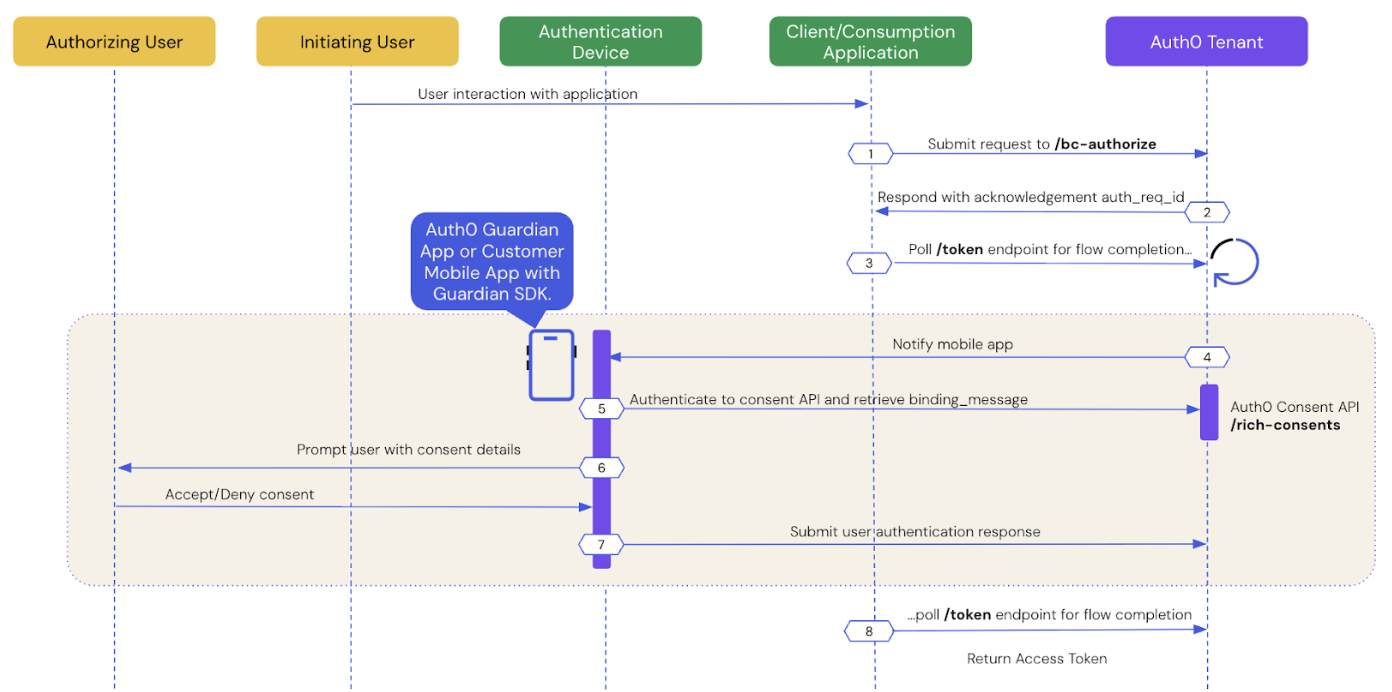 The following sections dive step-by-step into how user authentication works with CIBA using mobile push notifications.
* [Prerequisites](#prerequisites)
* [Step 1: Client application initiates a CIBA request](#step-1%3A-client-application-initiates-a-ciba-request)
* [Step 2: Auth0 tenant acknowledges the CIBA request](#step-2%3A-auth0-tenant-acknowledges-the-ciba-request)
* [Step 3: Client application polls for a response](#step-3%3A-client-application-polls-for-a-response)
* [Step 4: Mobile application receives the push notification](#step-4%3A-mobile-application-receives-the-push-notification)
* [Step 5: Mobile application retrieves the consent details](#step-5%3A-mobile-application-retrieves-the-consent-details)
* [Step 6: Mobile application presents the consent details to the user](#step-6%3A-mobile-application-presents-the-consent-details-to-the-user)
* [Step 7: Mobile application sends the user response back to Auth0](#step-7%3A-mobile-application-sends-the-user-response-back-to-auth0)
* [Step 8: Auth0 receives user response after the flow completes](#step-8%3A-auth0-receives-user-response-after-the-flow-completes)
* [Step 9: Auth0 returns access token to client application](#step-9%3A-auth0-returns-access-token-to-client-application)
## Prerequisites
To initiate a CIBA push request using Auth0, you must:
* [Configure Client-Initiated Backchannel Authentication](/docs/get-started/applications/configure-client-initiated-backchannel-authentication) for your tenant and application, including [mobile push notifications](/docs/get-started/applications/configure-client-initiated-backchannel-authentication/#configure-mobile-push-notifications).
* Set the `requested_expiry` parameter to a value of 300 or lower in seconds. To learn more, read [Configure notification channel](/docs/get-started/applications/configure-client-initiated-backchannel-authentication#configure-notification-channel).
## Step 1: Client application initiates a CIBA request
Use the [User Search APIs](/docs/manage-users/user-search) to find the authorizing user for whom you’d like to initiate a CIBA request and obtain their user ID.
Once you have a user ID for the authorizing user, use the Authentication API or our [SDKs](/docs/libraries) to send a CIBA request to the `/bc-authorize` endpoint:
```bash lines theme={null}
curl --location 'https://{YOUR_DOMAIN}.auth0.com/bc-authorize' \
--header 'Content-Type: application/x-www-form-urlencoded' \
--data-urlencode 'client_id={YOUR_CLIENT_ID}' \
--data-urlencode 'client_secret={YOUR_CLIENT_SECRET}' \
--data-urlencode 'login_hint={ "format": "iss_sub", "iss": "https://{YOUR_DOMAIN}.auth0.com/", "sub": "{USER_ID}" }' \
--data-urlencode 'scope={SCOPES}' \
--data-urlencode 'binding_message={BINDING_MESSAGE}'
```
```csharp lines theme={null}
var response = await authenticationApiClient.ClientInitiatedBackchannelAuthorization(
new ClientInitiatedBackchannelAuthorizationRequest()
{
ClientId = "{YOUR_CLIENT_ID}",
Scope = "openid",
ClientSecret = "{YOUR_CLIENT_SECRET}",
BindingMessage = "{BINDING_MESSAGE}",
LoginHint = new LoginHint()
{
Format = "iss_sub",
Issuer = "https://{YOUR_DOMAIN}.auth0.com/",
Subject = "{USER_ID}"
}
}
);
```
```go lines theme={null}
resp, err := authAPI.CIBA.Initiate(context.Background(), ciba.Request{
ClientID: mgmtClientID,
ClientSecret: mgmtClientSecret,
Scope: "openid",
LoginHint: map[string]string{
"format": "iss_sub",
"iss": "https://{YOUR_DOMAIN}.auth0.com/",
"sub": "{USER_ID}",
},
BindingMessage: "{BINDING_MESSAGE}",
})
```
```java lines theme={null}
//Creating AuthClient Instance
AuthAPI auth = AuthAPI.newBuilder(domain, clientId, clientSecret).build();
//Authorize
Map loginHint = new HashMap<>();
loginHint.put("format", "iss_sub");
loginHint.put("iss", "https://{YOUR_DOMAIN}.auth0.com/");
loginHint.put("sub", "{USER_ID}");
Request request = auth.authorizeBackChannel("openid", "{BINDING_MESSAGE}", loginHint);
BackChannelAuthorizeResponse resp = request.execute().getBody();
```
| Parameters | Description |
| ------------------ | ------------------------------------------------------------------------------------------------------------------------------------------------------------------------------------------------------------------------------------------------------------------------------------------------------------------------------------------------------------------------------------------------------------------------------------------------------------------------------------------------------------------------------------------------------------------------------------------------------------------------------------------------------------------------------------------------------------------------------------------------------------------ |
| `tenant` | Tenant name. It can also be a custom domain. If the `iss_sub` format is used, then the tenant name is passed within the `iss` claim. |
| `client_id` | Client application identifier. |
| `client_secret` | Client authentication method used for user authentication with CIBA, such as Client Secret, Private Key JWT, or mTLS Authentication. If you're using Private Key JWT or mTLS, you don't need to include the client secret. |
| `scope` | Must include `openid`.
The following sections dive step-by-step into how user authentication works with CIBA using mobile push notifications.
* [Prerequisites](#prerequisites)
* [Step 1: Client application initiates a CIBA request](#step-1%3A-client-application-initiates-a-ciba-request)
* [Step 2: Auth0 tenant acknowledges the CIBA request](#step-2%3A-auth0-tenant-acknowledges-the-ciba-request)
* [Step 3: Client application polls for a response](#step-3%3A-client-application-polls-for-a-response)
* [Step 4: Mobile application receives the push notification](#step-4%3A-mobile-application-receives-the-push-notification)
* [Step 5: Mobile application retrieves the consent details](#step-5%3A-mobile-application-retrieves-the-consent-details)
* [Step 6: Mobile application presents the consent details to the user](#step-6%3A-mobile-application-presents-the-consent-details-to-the-user)
* [Step 7: Mobile application sends the user response back to Auth0](#step-7%3A-mobile-application-sends-the-user-response-back-to-auth0)
* [Step 8: Auth0 receives user response after the flow completes](#step-8%3A-auth0-receives-user-response-after-the-flow-completes)
* [Step 9: Auth0 returns access token to client application](#step-9%3A-auth0-returns-access-token-to-client-application)
## Prerequisites
To initiate a CIBA push request using Auth0, you must:
* [Configure Client-Initiated Backchannel Authentication](/docs/get-started/applications/configure-client-initiated-backchannel-authentication) for your tenant and application, including [mobile push notifications](/docs/get-started/applications/configure-client-initiated-backchannel-authentication/#configure-mobile-push-notifications).
* Set the `requested_expiry` parameter to a value of 300 or lower in seconds. To learn more, read [Configure notification channel](/docs/get-started/applications/configure-client-initiated-backchannel-authentication#configure-notification-channel).
## Step 1: Client application initiates a CIBA request
Use the [User Search APIs](/docs/manage-users/user-search) to find the authorizing user for whom you’d like to initiate a CIBA request and obtain their user ID.
Once you have a user ID for the authorizing user, use the Authentication API or our [SDKs](/docs/libraries) to send a CIBA request to the `/bc-authorize` endpoint:
```bash lines theme={null}
curl --location 'https://{YOUR_DOMAIN}.auth0.com/bc-authorize' \
--header 'Content-Type: application/x-www-form-urlencoded' \
--data-urlencode 'client_id={YOUR_CLIENT_ID}' \
--data-urlencode 'client_secret={YOUR_CLIENT_SECRET}' \
--data-urlencode 'login_hint={ "format": "iss_sub", "iss": "https://{YOUR_DOMAIN}.auth0.com/", "sub": "{USER_ID}" }' \
--data-urlencode 'scope={SCOPES}' \
--data-urlencode 'binding_message={BINDING_MESSAGE}'
```
```csharp lines theme={null}
var response = await authenticationApiClient.ClientInitiatedBackchannelAuthorization(
new ClientInitiatedBackchannelAuthorizationRequest()
{
ClientId = "{YOUR_CLIENT_ID}",
Scope = "openid",
ClientSecret = "{YOUR_CLIENT_SECRET}",
BindingMessage = "{BINDING_MESSAGE}",
LoginHint = new LoginHint()
{
Format = "iss_sub",
Issuer = "https://{YOUR_DOMAIN}.auth0.com/",
Subject = "{USER_ID}"
}
}
);
```
```go lines theme={null}
resp, err := authAPI.CIBA.Initiate(context.Background(), ciba.Request{
ClientID: mgmtClientID,
ClientSecret: mgmtClientSecret,
Scope: "openid",
LoginHint: map[string]string{
"format": "iss_sub",
"iss": "https://{YOUR_DOMAIN}.auth0.com/",
"sub": "{USER_ID}",
},
BindingMessage: "{BINDING_MESSAGE}",
})
```
```java lines theme={null}
//Creating AuthClient Instance
AuthAPI auth = AuthAPI.newBuilder(domain, clientId, clientSecret).build();
//Authorize
Map loginHint = new HashMap<>();
loginHint.put("format", "iss_sub");
loginHint.put("iss", "https://{YOUR_DOMAIN}.auth0.com/");
loginHint.put("sub", "{USER_ID}");
Request request = auth.authorizeBackChannel("openid", "{BINDING_MESSAGE}", loginHint);
BackChannelAuthorizeResponse resp = request.execute().getBody();
```
| Parameters | Description |
| ------------------ | ------------------------------------------------------------------------------------------------------------------------------------------------------------------------------------------------------------------------------------------------------------------------------------------------------------------------------------------------------------------------------------------------------------------------------------------------------------------------------------------------------------------------------------------------------------------------------------------------------------------------------------------------------------------------------------------------------------------------------------------------------------------ |
| `tenant` | Tenant name. It can also be a custom domain. If the `iss_sub` format is used, then the tenant name is passed within the `iss` claim. |
| `client_id` | Client application identifier. |
| `client_secret` | Client authentication method used for user authentication with CIBA, such as Client Secret, Private Key JWT, or mTLS Authentication. If you're using Private Key JWT or mTLS, you don't need to include the client secret. |
| `scope` | Must include `openid`.
The scope can optionally include `offline_access` to request a refresh token. However, for one-time authorization of a transaction with the CIBA Flow, a refresh token is not needed and does not have any meaning in this context. |
| `user_id` | User ID for the authorizing user that is passed within the `login_hint` structure. If `iss_sub` format is used, then the user ID is passed within the `sub` claim.
The user ID may have a different format depending on the external provider. |
| `requested_expiry` | The maximum duration, in seconds, for which the CIBA session should be valid. The CIBA flow's requested expiry is between 1 and 259200 seconds (72 hours), and it defaults to 300 seconds. Include the `requested_expiry` parameter to set a custom expiry for the CIBA flow.
The `requested_expiry` parameter helps determine which notification channel CIBA uses:- If you set your `requested_expiry` to a value of 300 or lower in seconds, CIBA uses the mobile push notification channel if enabled. If you have not configured MFA for your tenant, the CIBA request fails.
- If you set your `requested_expiry` to a value between 301 to 259200 seconds (72 hours), CIBA uses the email notification channel if enabled.
|
| `binding_message` | Human-readable message used to bind the CIBA flow across the authentication and consumption devices. The binding message is required and up to 64 characters. Use only alphanumeric and `+-_.,:#` characters. |
There is a user-specific rate limit where the authorizing user will not be sent more than 5 requests per minute.
## Step 2: Auth0 tenant acknowledges the CIBA request
If the Auth0 tenant successfully receives the `POST` request, you should receive a response containing an `auth-req-id` that references the request:
```json lines theme={null}
{
"auth_req_id": "eyJh...",
"expires_in": 300,
"interval": 5
}
```
The `auth_req_id` value is passed to the `/token` endpoint to poll for the completion of the CIBA flow.
## Step 3: Client application polls for a response
Use the Authentication API or our [SDKs](/docs/libraries) to call the `/token` endpoint using the `urn:openid:params:grant-type:ciba` grant type and the `auth_req_id` you received from the `/bc-authorize` endpoint:
```bash lines theme={null}
curl --location 'https://$tenant.auth0.com/oauth/token' \
--header 'Content-Type: application/x-www-form-urlencoded' \
--data-urlencode 'client_id=' \
--data-urlencode 'client_secret=' \
--data-urlencode 'auth_req_id=' \
--data-urlencode 'grant_type=urn:openid:params:grant-type:ciba'
```
```csharp lines theme={null}
var token = await authenticationApiClient.GetTokenAsync(
new ClientInitiatedBackchannelAuthorizationTokenRequest()
{
AuthRequestId = response.AuthRequestId,
ClientId = "",
ClientSecret = ""
}
);
```
```go lines theme={null}
token, err := authAPI.OAuth.LoginWithGrant(context.Background(),
"urn:openid:params:grant-type:ciba",
url.Values{
"auth_req_id": []string{resp.AuthReqID},
"client_id": []string{clientID},
"client_secret": []string{clientSecret},
},
oauth.IDTokenValidationOptions{})
```
```java lines theme={null}
Request tokenRequest = auth.getBackChannelLoginStatus(authReqId, "grant-type");
BackChannelTokenResponse tokenResponse = tokenRequest.execute().getBody();
```
Until the authorizing user approves the transaction, you should receive the following response:
```json lines theme={null}
{
"error": "authorization_pending",
"error_description": "The end-user authorization is pending"
}
```
There is approximately a five-second wait interval for polling. If you poll too frequently, you will receive the following response, where the description varies depending on the backoff interval:
```json lines theme={null}
{
"error": "slow_down",
"error_description": "You are polling faster than allowed. Try again in 10 seconds."
"interval": 10
}
```
To resolve the error, wait until the next interval (in seconds) to poll the `/token` endpoint.
## Step 4: Mobile application receives the push notification
Auth0 sends a push notification to the user's registered mobile app or device via the Auth0 Guardian app or a custom app integrated with the [Auth0 Guardian SDK](/docs/secure/multi-factor-authentication/auth0-guardian).
If you're using a custom app, the [Auth0 Guardian SDK](/docs/secure/multi-factor-authentication/auth0-guardian) provides methods to parse the data received from the push notification and return a ready-to-use `Notification` instance. The `Notification` instance includes a transaction linking ID, or `txlinkid`, that the mobile application uses to retrieve the consent details from Auth0.
The following code samples are example iOS and Android mobile push notification implementations using the Guardian SDK:
```swift lines theme={null}
//implementing UNUserNotificationCenterDelegate
func userNotificationCenter(_ center: UNUserNotificationCenter, willPresent notification: UNNotification, withCompletionHandler completionHandler: (UNNotificationPresentationOptions) -> Void) {
let userInfo = notification.request.content.userInfo
if let notification = Guardian.notification(from: userInfo) {
// Implement this function to display the prompt and handle user's consent/rejection.
handleGuardianNotification(notification: notification)
}
}
```
```kotlin lines theme={null}
// at the FCM listener you receive a RemoteMessage
@Override
public void onMessageReceived(RemoteMessage message) {
Notification notification = Guardian.parseNotification(message.getData());
if (notification != null) {
// you received a Guardian notification, handle it
handleGuardianNotification(notification);
return;
}
/* handle other push notifications you might be using ... */
}
```
## Step 5: Mobile application retrieves the consent details
Your Auth0 Guardian app or custom app integrated with the Auth0 Guardian SDK retrieves the consent details i.e. the contents of the `binding_message` from the Auth0 Consent API.
If you're using a custom app, the following code samples are example iOS and Android implementations that retrieve data from the Auth0 Consent API:
```swift lines theme={null}
let device: AuthenticationDevice = // the object you obtained during the initial Guardian SDK enrollment process and stored locally
if let consentId = notification.transactionLinkingId {
Guardian
.consent(forDomain: {yourTenantDomain}, device: device)
.fetch(consentId: consentId, notificationToken: notification.transactionToken)
.start{result in
switch result {
case .success(let payload):
// present consent details to the user
case .failure(let cause):
// something went wrong
}
}
}
```
```kotlin lines theme={null}
Enrollment enrollment = // the object you obtained during the initial Guardian SDK enrollment process and stored locally
if (notification.getTransactionLinkingId() != null) {
guardian
.fetchConsent(notification, enrollment)
.start(new Callback {
@Override
void onSuccess(RichConsent consentDetails) {
// present consent details to the user
}
@Override
void onFailure(Throwable exception) {
// something went wrong
}
});
}
```
## Step 6: Mobile application presents the consent details to the user
The Auth0 Consent API responds to the Auth0 Guardian app or your custom app integrated with the Auth0 Guardian SDK with the consent details, including the `binding_message`, `scope`, and `audience`. The scopes returned to the mobile application are filtered according to your RBAC policy. To learn more, read [Role-Based Access Control](/docs/manage-users/access-control/rbac).
The mobile application presents the authentication request and/or the consent details to the user.
The following code sample is an example response from the Auth0 Consent API:
```json lines theme={null}
{
"id": "cns_abc123",
"requested_details": {
"audience": "https://$tenant.auth0.com/userinfo",
"scope": ["openid"],
"binding_message": "21-49-38"
},
"created_at": 1746693720
"expires_at": 1746693750
}
```
The user can accept or decline the authentication request at this point.
## Step 7: Mobile application sends the user response back to Auth0
The Auth0 Guardian app or your custom app sends the user response back to Auth0.
If you're using a custom app integrated with the Auth0 Guardian SDK, the following code samples are example iOS and Android implementations that handle the user response:
### User accepts the authentication request
```swift lines theme={null}
Guardian
.authentication(forDomain: "{yourTenantDomain}", device: device)
.allow(notification: notification)
// or reject(notification: notification, withReason: "hacked")
.start { result in
switch result {
case .success:
// the auth request was successfully rejected
case .failure(let cause):
// something failed, check cause to see what went wrong
}
}
```
```kotlin lines theme={null}
guardian
.allow(notification, enrollment)
.execute(); // or start(new Callback<> ...)
```
### User rejects the authentication request
```swift lines theme={null}
Guardian
.authentication(forDomain: "{yourTenantDomain}", device: device)
.reject(notification: notification)
// or reject(notification: notification, withReason: "hacked")
.start { result in
switch result {
case .success:
// the auth request was successfully rejected
case .failure(let cause):
// something failed, check cause to see what went wrong
}
}
```
```kotlin lines theme={null}
guardian
.reject(notification, enrollment) // or reject(notification, enrollment, reason)
.execute(); // or start(new Callback<> ...)
```
## Step 8: Auth0 receives user response after the flow completes
The client application completes the polling upon receiving a response from the `/token` endpoint. A CIBA flow always requires a response, either an approval or decline, from the authorizing user, and existing grants are not checked.
## Step 9: Auth0 returns access token to client application
If the user rejects the push request, Auth0 returns an error response like the following to the client application:
```json lines theme={null}
{
"error": "access_denied",
"error_description": "The end-user denied the authorization request or it has been expired"
}
```
If the user approves the push request, Auth0 returns an access token like the following to the client application:
```json lines theme={null}
{
"access_token": "eyJh...",
"id_token": "eyJh...",
"expires_in": 86400,
"scope": "openid",
"token_type": "Bearer"
}
```
The `refresh_token` will only be present if the `offline_access` scope was included in the initial `/bc-authorize` request.
## Learn more
* [Client-Initiated Backchannel Authentication Flow](/docs/get-started/authentication-and-authorization-flow/client-initiated-backchannel-authentication-flow)
* [Configure Client-Initiated Backchannel Authentication](/docs/get-started/applications/configure-client-initiated-backchannel-authentication)