> ## Documentation Index
> Fetch the complete documentation index at: https://auth0.com/llms.txt
> Use this file to discover all available pages before exploring further.
> Learn how to remove permissions directly assigned to a user using the Auth0 Dashboard or the Management API.
# Remove Permissions from Users
export const AuthCodeGroup = ({children, dropdown}) => {
const [processedChildren, setProcessedChildren] = useState(children);
useEffect(() => {
let unsubscribe = null;
function init() {
unsubscribe = window.autorun(() => {
const processChildren = node => {
if (typeof node === "string") {
let processedNode = node;
for (const [key, value] of window.rootStore.variableStore.values.entries()) {
const escapedKey = key.replaceAll(/[.*+?^${}()|[\]\\]/g, (String.raw)`\$&`);
processedNode = processedNode.replaceAll(new RegExp(escapedKey, "g"), value);
}
return processedNode;
} else if (Array.isArray(node)) {
return node.map(processChildren);
} else if (node && node.props && node.props.children) {
return {
...node,
props: {
...node.props,
children: processChildren(node.props.children)
}
};
}
return node;
};
setProcessedChildren(processChildren(children));
});
}
if (window.rootStore) {
init();
} else {
window.addEventListener("adu:storeReady", init);
}
return () => {
window.removeEventListener("adu:storeReady", init);
unsubscribe?.();
};
}, [children]);
return {processedChildren};
};
export const AuthCodeBlock = ({filename, icon, language, highlight, children}) => {
const [displayText, setDisplayText] = useState(children);
const [copyText, setCopyText] = useState(children);
const wrapperRef = React.useRef(null);
useEffect(() => {
let unsubscribe = null;
function init() {
if (!window.autorun || !window.rootStore) {
return;
}
unsubscribe = window.autorun(() => {
let processedChildrenForDisplay = children;
let processedChildrenForCopy = children;
for (const [key, value] of window.rootStore.variableStore.values.entries()) {
const escapedKey = key.replaceAll(/[.*+?^${}()|[\]\\]/g, (String.raw)`\$&`);
let displayValue = value;
if (key === "{yourClientSecret}" && value !== "{yourClientSecret}") {
displayValue = value.substring(0, 3) + "*****MASKED*****";
}
processedChildrenForDisplay = processedChildrenForDisplay.replaceAll(new RegExp(escapedKey, "g"), displayValue);
processedChildrenForCopy = processedChildrenForCopy.replaceAll(new RegExp(escapedKey, "g"), value);
}
setDisplayText(processedChildrenForDisplay);
setCopyText(processedChildrenForCopy);
});
}
if (window.rootStore) {
init();
} else {
window.addEventListener("adu:storeReady", init);
}
return () => {
window.removeEventListener("adu:storeReady", init);
unsubscribe?.();
};
}, [children]);
useEffect(() => {
if (!wrapperRef.current) return;
const originalWriteText = navigator.clipboard.writeText.bind(navigator.clipboard);
let isOverriding = false;
const handleClick = e => {
const button = e.target.closest('[data-testid="copy-code-button"]');
if (!button || !wrapperRef.current.contains(button)) return;
isOverriding = true;
navigator.clipboard.writeText = text => {
if (isOverriding) {
isOverriding = false;
navigator.clipboard.writeText = originalWriteText;
return originalWriteText(copyText);
}
return originalWriteText(text);
};
setTimeout(() => {
if (isOverriding) {
isOverriding = false;
navigator.clipboard.writeText = originalWriteText;
}
}, 100);
};
const wrapper = wrapperRef.current;
wrapper.addEventListener('click', handleClick, true);
return () => {
wrapper.removeEventListener('click', handleClick, true);
if (navigator.clipboard.writeText !== originalWriteText) {
navigator.clipboard.writeText = originalWriteText;
}
};
}, [copyText]);
return
{displayText}
;
};
You can remove the permissions directly assigned to a user using the Auth0 Dashboard or the Management API. The assigned permissions are used with the API Authorization Core feature set. To learn more, read [Role-Based Access Control](/docs/manage-users/access-control/rbac).
## Prerequisites
For role-based access control (RBAC) to work properly, you must enable it for your API using either the Dashboard or the Management API. The Authorization Core functionality is different from the Authorization Extension. For a comparison, read [Authorization Core vs. Authorization Extension](/docs/manage-users/access-control/authorization-core-vs-authorization-extension).
## Use the Dashboard
1. Go to [Dashboard > User Management > Users](https://manage.auth0.com/#/users) and click the name of the user.
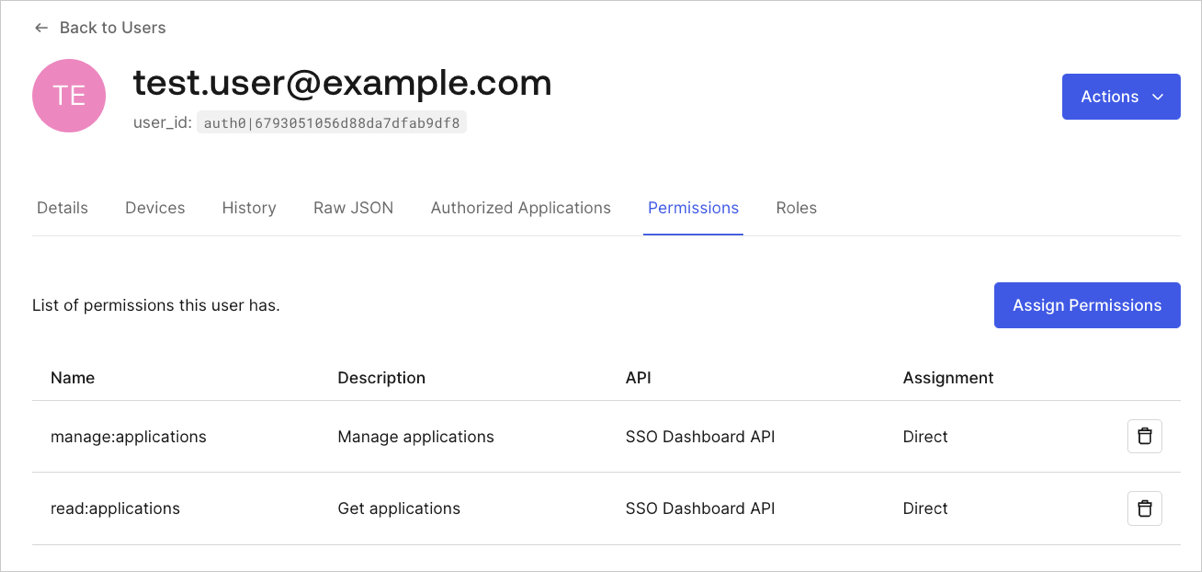
2. Click the **Permissions** view, then click the trash can icon next to the permission you want to remove, and confirm.
 ## Use the Management API
Make a `DELETE` call to the [Delete User Permissions endpoint](https://auth0.com/docs/api/management/v2#!/Users/delete_permissions). Be sure to replace `USER_ID`, `MGMT_API_ACCESS_TOKEN`, `API_ID`, and `PERMISSION_NAME` placeholder values with your user ID, Management API access token, API ID(s), and permission name(s), respectively.
```bash cURL theme={null}
curl --request DELETE \
--url 'https://{yourDomain}/api/v2/users/USER_ID/permissions' \
--header 'authorization: Bearer MGMT_API_ACCESS_TOKEN' \
--header 'cache-control: no-cache' \
--header 'content-type: application/json' \
--data '{ "permissions": [ { "resource_server_identifier": "API_ID", "permission_name": "PERMISSION_NAME" }, { "resource_server_identifier": "API_ID", "permission_name": "PERMISSION_NAME" } ] }'
```
```csharp C# theme={null}
var client = new RestClient("https://{yourDomain}/api/v2/users/USER_ID/permissions");
var request = new RestRequest(Method.DELETE);
request.AddHeader("content-type", "application/json");
request.AddHeader("authorization", "Bearer MGMT_API_ACCESS_TOKEN");
request.AddHeader("cache-control", "no-cache");
request.AddParameter("application/json", "{ "permissions": [ { "resource_server_identifier": "API_ID", "permission_name": "PERMISSION_NAME" }, { "resource_server_identifier": "API_ID", "permission_name": "PERMISSION_NAME" } ] }", ParameterType.RequestBody);
IRestResponse response = client.Execute(request);
```
```go Go theme={null}
package main
import (
"fmt"
"strings"
"net/http"
"io/ioutil"
)
func main() {
url := "https://{yourDomain}/api/v2/users/USER_ID/permissions"
payload := strings.NewReader("{ "permissions": [ { "resource_server_identifier": "API_ID", "permission_name": "PERMISSION_NAME" }, { "resource_server_identifier": "API_ID", "permission_name": "PERMISSION_NAME" } ] }")
req, _ := http.NewRequest("DELETE", url, payload)
req.Header.Add("content-type", "application/json")
req.Header.Add("authorization", "Bearer MGMT_API_ACCESS_TOKEN")
req.Header.Add("cache-control", "no-cache")
res, _ := http.DefaultClient.Do(req)
defer res.Body.Close()
body, _ := ioutil.ReadAll(res.Body)
fmt.Println(res)
fmt.Println(string(body))
}
```
```java Java theme={null}
HttpResponse response = Unirest.delete("https://{yourDomain}/api/v2/users/USER_ID/permissions")
.header("content-type", "application/json")
.header("authorization", "Bearer MGMT_API_ACCESS_TOKEN")
.header("cache-control", "no-cache")
.body("{ "permissions": [ { "resource_server_identifier": "API_ID", "permission_name": "PERMISSION_NAME" }, { "resource_server_identifier": "API_ID", "permission_name": "PERMISSION_NAME" } ] }")
.asString();
```
```javascript Node.JS theme={null}
var axios = require("axios").default;
var options = {
method: 'DELETE',
url: 'https://{yourDomain}/api/v2/users/USER_ID/permissions',
headers: {
'content-type': 'application/json',
authorization: 'Bearer MGMT_API_ACCESS_TOKEN',
'cache-control': 'no-cache'
},
data: {
permissions: [
{resource_server_identifier: 'API_ID', permission_name: 'PERMISSION_NAME'},
{resource_server_identifier: 'API_ID', permission_name: 'PERMISSION_NAME'}
]
}
};
axios.request(options).then(function (response) {
console.log(response.data);
}).catch(function (error) {
console.error(error);
});
```
```php PHP theme={null}
$curl = curl_init();
curl_setopt_array($curl, [
CURLOPT_URL => "https://{yourDomain}/api/v2/users/USER_ID/permissions",
CURLOPT_RETURNTRANSFER => true,
CURLOPT_ENCODING => "",
CURLOPT_MAXREDIRS => 10,
CURLOPT_TIMEOUT => 30,
CURLOPT_HTTP_VERSION => CURL_HTTP_VERSION_1_1,
CURLOPT_CUSTOMREQUEST => "DELETE",
CURLOPT_POSTFIELDS => "{ "permissions": [ { "resource_server_identifier": "API_ID", "permission_name": "PERMISSION_NAME" }, { "resource_server_identifier": "API_ID", "permission_name": "PERMISSION_NAME" } ] }",
CURLOPT_HTTPHEADER => [
"authorization: Bearer MGMT_API_ACCESS_TOKEN",
"cache-control: no-cache",
"content-type: application/json"
],
]);
$response = curl_exec($curl);
$err = curl_error($curl);
curl_close($curl);
if ($err) {
echo "cURL Error #:" . $err;
} else {
echo $response;
}
```
```python Python theme={null}
import http.client
conn = http.client.HTTPSConnection("")
payload = "{ "permissions": [ { "resource_server_identifier": "API_ID", "permission_name": "PERMISSION_NAME" }, { "resource_server_identifier": "API_ID", "permission_name": "PERMISSION_NAME" } ] }"
headers = {
'content-type': "application/json",
'authorization': "Bearer MGMT_API_ACCESS_TOKEN",
'cache-control': "no-cache"
}
conn.request("DELETE", "/{yourDomain}/api/v2/users/USER_ID/permissions", payload, headers)
res = conn.getresponse()
data = res.read()
print(data.decode("utf-8"))
```
```ruby Ruby theme={null}
require 'uri'
require 'net/http'
require 'openssl'
url = URI("https://{yourDomain}/api/v2/users/USER_ID/permissions")
http = Net::HTTP.new(url.host, url.port)
http.use_ssl = true
http.verify_mode = OpenSSL::SSL::VERIFY_NONE
request = Net::HTTP::Delete.new(url)
request["content-type"] = 'application/json'
request["authorization"] = 'Bearer MGMT_API_ACCESS_TOKEN'
request["cache-control"] = 'no-cache'
request.body = "{ "permissions": [ { "resource_server_identifier": "API_ID", "permission_name": "PERMISSION_NAME" }, { "resource_server_identifier": "API_ID", "permission_name": "PERMISSION_NAME" } ] }"
response = http.request(request)
puts response.read_body
```
| Value | Description |
| ----------------------- | --------------------------------------------------------------------------------------------------------------------- |
| `USER_ID` | Τhe ID of the user to be updated. |
| `MGMT_API_ACCESS_TOKEN` | [Access Token for the Management API](https://auth0.com/docs/api/management/v2/tokens) with the scope `update:users`. |
| `API_ID` | ID(s) of the API(s) associated with the permission(s) you would like to remove for the specified user. |
| `PERMISSION_NAME` | Name(s) of the permission(s) you would like to remove for the specified user. |
## Learn more
* [Assign Permissions to Users](/docs/manage-users/access-control/configure-core-rbac/rbac-users/assign-permissions-to-users)
* [Remove Permissions from Roles](/docs/manage-users/access-control/configure-core-rbac/roles/remove-permissions-from-roles)
* [View Role Permissions](/docs/manage-users/access-control/configure-core-rbac/roles/view-role-permissions)
* [Manage Role-Based Access Control Permissions](/docs/manage-users/access-control/configure-core-rbac/manage-permissions)
## Use the Management API
Make a `DELETE` call to the [Delete User Permissions endpoint](https://auth0.com/docs/api/management/v2#!/Users/delete_permissions). Be sure to replace `USER_ID`, `MGMT_API_ACCESS_TOKEN`, `API_ID`, and `PERMISSION_NAME` placeholder values with your user ID, Management API access token, API ID(s), and permission name(s), respectively.
```bash cURL theme={null}
curl --request DELETE \
--url 'https://{yourDomain}/api/v2/users/USER_ID/permissions' \
--header 'authorization: Bearer MGMT_API_ACCESS_TOKEN' \
--header 'cache-control: no-cache' \
--header 'content-type: application/json' \
--data '{ "permissions": [ { "resource_server_identifier": "API_ID", "permission_name": "PERMISSION_NAME" }, { "resource_server_identifier": "API_ID", "permission_name": "PERMISSION_NAME" } ] }'
```
```csharp C# theme={null}
var client = new RestClient("https://{yourDomain}/api/v2/users/USER_ID/permissions");
var request = new RestRequest(Method.DELETE);
request.AddHeader("content-type", "application/json");
request.AddHeader("authorization", "Bearer MGMT_API_ACCESS_TOKEN");
request.AddHeader("cache-control", "no-cache");
request.AddParameter("application/json", "{ "permissions": [ { "resource_server_identifier": "API_ID", "permission_name": "PERMISSION_NAME" }, { "resource_server_identifier": "API_ID", "permission_name": "PERMISSION_NAME" } ] }", ParameterType.RequestBody);
IRestResponse response = client.Execute(request);
```
```go Go theme={null}
package main
import (
"fmt"
"strings"
"net/http"
"io/ioutil"
)
func main() {
url := "https://{yourDomain}/api/v2/users/USER_ID/permissions"
payload := strings.NewReader("{ "permissions": [ { "resource_server_identifier": "API_ID", "permission_name": "PERMISSION_NAME" }, { "resource_server_identifier": "API_ID", "permission_name": "PERMISSION_NAME" } ] }")
req, _ := http.NewRequest("DELETE", url, payload)
req.Header.Add("content-type", "application/json")
req.Header.Add("authorization", "Bearer MGMT_API_ACCESS_TOKEN")
req.Header.Add("cache-control", "no-cache")
res, _ := http.DefaultClient.Do(req)
defer res.Body.Close()
body, _ := ioutil.ReadAll(res.Body)
fmt.Println(res)
fmt.Println(string(body))
}
```
```java Java theme={null}
HttpResponse response = Unirest.delete("https://{yourDomain}/api/v2/users/USER_ID/permissions")
.header("content-type", "application/json")
.header("authorization", "Bearer MGMT_API_ACCESS_TOKEN")
.header("cache-control", "no-cache")
.body("{ "permissions": [ { "resource_server_identifier": "API_ID", "permission_name": "PERMISSION_NAME" }, { "resource_server_identifier": "API_ID", "permission_name": "PERMISSION_NAME" } ] }")
.asString();
```
```javascript Node.JS theme={null}
var axios = require("axios").default;
var options = {
method: 'DELETE',
url: 'https://{yourDomain}/api/v2/users/USER_ID/permissions',
headers: {
'content-type': 'application/json',
authorization: 'Bearer MGMT_API_ACCESS_TOKEN',
'cache-control': 'no-cache'
},
data: {
permissions: [
{resource_server_identifier: 'API_ID', permission_name: 'PERMISSION_NAME'},
{resource_server_identifier: 'API_ID', permission_name: 'PERMISSION_NAME'}
]
}
};
axios.request(options).then(function (response) {
console.log(response.data);
}).catch(function (error) {
console.error(error);
});
```
```php PHP theme={null}
$curl = curl_init();
curl_setopt_array($curl, [
CURLOPT_URL => "https://{yourDomain}/api/v2/users/USER_ID/permissions",
CURLOPT_RETURNTRANSFER => true,
CURLOPT_ENCODING => "",
CURLOPT_MAXREDIRS => 10,
CURLOPT_TIMEOUT => 30,
CURLOPT_HTTP_VERSION => CURL_HTTP_VERSION_1_1,
CURLOPT_CUSTOMREQUEST => "DELETE",
CURLOPT_POSTFIELDS => "{ "permissions": [ { "resource_server_identifier": "API_ID", "permission_name": "PERMISSION_NAME" }, { "resource_server_identifier": "API_ID", "permission_name": "PERMISSION_NAME" } ] }",
CURLOPT_HTTPHEADER => [
"authorization: Bearer MGMT_API_ACCESS_TOKEN",
"cache-control: no-cache",
"content-type: application/json"
],
]);
$response = curl_exec($curl);
$err = curl_error($curl);
curl_close($curl);
if ($err) {
echo "cURL Error #:" . $err;
} else {
echo $response;
}
```
```python Python theme={null}
import http.client
conn = http.client.HTTPSConnection("")
payload = "{ "permissions": [ { "resource_server_identifier": "API_ID", "permission_name": "PERMISSION_NAME" }, { "resource_server_identifier": "API_ID", "permission_name": "PERMISSION_NAME" } ] }"
headers = {
'content-type': "application/json",
'authorization': "Bearer MGMT_API_ACCESS_TOKEN",
'cache-control': "no-cache"
}
conn.request("DELETE", "/{yourDomain}/api/v2/users/USER_ID/permissions", payload, headers)
res = conn.getresponse()
data = res.read()
print(data.decode("utf-8"))
```
```ruby Ruby theme={null}
require 'uri'
require 'net/http'
require 'openssl'
url = URI("https://{yourDomain}/api/v2/users/USER_ID/permissions")
http = Net::HTTP.new(url.host, url.port)
http.use_ssl = true
http.verify_mode = OpenSSL::SSL::VERIFY_NONE
request = Net::HTTP::Delete.new(url)
request["content-type"] = 'application/json'
request["authorization"] = 'Bearer MGMT_API_ACCESS_TOKEN'
request["cache-control"] = 'no-cache'
request.body = "{ "permissions": [ { "resource_server_identifier": "API_ID", "permission_name": "PERMISSION_NAME" }, { "resource_server_identifier": "API_ID", "permission_name": "PERMISSION_NAME" } ] }"
response = http.request(request)
puts response.read_body
```
| Value | Description |
| ----------------------- | --------------------------------------------------------------------------------------------------------------------- |
| `USER_ID` | Τhe ID of the user to be updated. |
| `MGMT_API_ACCESS_TOKEN` | [Access Token for the Management API](https://auth0.com/docs/api/management/v2/tokens) with the scope `update:users`. |
| `API_ID` | ID(s) of the API(s) associated with the permission(s) you would like to remove for the specified user. |
| `PERMISSION_NAME` | Name(s) of the permission(s) you would like to remove for the specified user. |
## Learn more
* [Assign Permissions to Users](/docs/manage-users/access-control/configure-core-rbac/rbac-users/assign-permissions-to-users)
* [Remove Permissions from Roles](/docs/manage-users/access-control/configure-core-rbac/roles/remove-permissions-from-roles)
* [View Role Permissions](/docs/manage-users/access-control/configure-core-rbac/roles/view-role-permissions)
* [Manage Role-Based Access Control Permissions](/docs/manage-users/access-control/configure-core-rbac/manage-permissions)